
Some countries carry enormous debts for decades, borrowing, investing and meeting their obligations without crisis. Others owe far less, yet find themselves refinancing constantly, paying increasingly expensive interest and watching every approaching maturity date.
The difference tells us something important about this country’s E42 billion debt. How much a country owes is only the beginning of the story.
Government debt now stands at about E42 billion, roughly 40.4 per cent of GDP. It is a large number, certainly, but not an extraordinary one by regional or international standards. On that measure alone, Eswatini does not look like a country drowning in debt.
Look beyond the size of the debt, however, and the picture becomes more interesting. Some of the money has financed infrastructure and other investments intended to strengthen the economy for years to come. Yet government is also running persistent budget deficits, interest costs are rising, part of its revenue can swing sharply from one year to another, and some new borrowing must be used to settle older debt as it falls due.
Suddenly, E42 billion is no longer the most interesting number in the room. What matters is what it costs to carry, when it must be repaid and how much of tomorrow’s income has already been promised to yesterday’s decisions.
That was the distinction at the heart of the first part of this edition. Debt itself is neither evidence of failure nor proof of recklessness. The trouble begins when borrowing stops expanding tomorrow’s capacity and increasingly starts keeping today’s obligations afloat. Or, as we put it last week, that’s where, as the youngsters would say, the danger is.
This week, we follow the money one step further. Not towards another frightening debt total, but towards something much closer to home, the repayment.
Because whether the borrower is a government with a multibillion-Emalangeni budget, an SME waiting for a customer to settle an invoice or a household counting the days until payday, debt eventually arrives at the same place.
The money must leave the account. And that is when we discover what the borrowing really costs.
Bill after borrowing
Imagine borrowing E100 000. The E100 000 gets all the attention. It is printed boldly on the agreement. It pays for the car, equipment, extension or emergency that made you walk into the bank in the first place.
Then the repayments begin. Month after month, money leaves your account. Yet when you eventually inspect the statement, the balance has fallen by far less than the total amount you have paid.
There sits the cost of debt. Interest.
Governments live with the same arithmetic. The national budget shows interest payments approaching E4 billion annually within total spending of roughly E37 billion.
That changes how we should read the E42 billion headline. Interest does not build another road. It does not buy medicines or put more youngsters in tertiary. It is the price of money already spent.
There is nothing unusual about paying it; borrowing has a cost. The concern begins when that cost starts claiming enough of today’s income to restrict what can be done tomorrow.
A household knows the feeling. You make the loan repayment faithfully every month. The bank takes its money. Then the school asks for something unexpected, the car develops an expensive sound and the refrigerator decides that seven years of service was quite enough.
The problem is no longer simply what you owe. It is what the repayment leaves behind.
Debt has a calendar too
Cost is only half the story. Debt also comes with dates. Part of the country’s debt, particularly domestic borrowing, has relatively short maturities. That means government must regularly repay or refinance obligations as they fall due.
Refinancing itself is not evidence of trouble. Governments and companies do it routinely. Even homeowners refinance when better terms become available.
The important question is why. There is a world of difference between replacing an expensive loan because you have found cheaper finance and taking another loan because Friday’s repayment has arrived before the money to meet it. One is a choice. The other is necessity wearing the clothes of choice.
That distinction becomes especially important when government revenue does not arrive with the same certainty as its obligations.
Eswatini receives a substantial share of public revenue through SACU receipts. Those receipts can rise handsomely in one year and retreat sharply in another. Interest payments are less accommodating. So are salaries, existing contracts and maturing loans.
This is where a debt question quietly becomes a cash-flow question.
And anyone who has ever run a small business knows just how dangerous that distinction can become.
When debt becomes a cash-flow problem
Anyone who has run a small business knows that profit and cash are not the same thing.
A contractor can finish a job in January, issue an invoice and record a healthy profit. The client promises payment in 60 days. The employees are less patient. Salaries arrive at month-end. The landlord wants rent. Suppliers want payment before releasing more stock. By February, the business may have thousands of Emalangeni coming its way and too little money in the bank to meet today’s obligations.
On paper, it is profitable. At the bank, it is struggling.
Governments operate on a vastly different scale, but timing still matters. Revenue arrives from taxes, SACU receipts and other sources, while salaries, suppliers, interest payments and maturing debt arrive according to their own calendars.
Eswatini has an additional vulnerability because a substantial share of government revenue comes from SACU receipts, which can change sharply from one year to another. The obligations are less flexible. Interest does not politely shrink because SACU revenue has fallen. Neither do salaries, existing contracts or loans reaching maturity.
That mismatch is one reason the country’s debt position cannot be understood from the debt-toGDP ratio alone. A country may have the economic capacity to repay its debts over time and still experience pressure because too much money is required at the wrong moment.
The Minister of Finance described the problem plainly in his responses to senators’ questions this week. Money is constantly coming in and money is constantly going out, he explained, and the two are never synchronised. “Sometimes there’s more coming to Treasury, sometimes less.”
What makes his account striking is that the current squeeze arrived just as the books looked their healthiest. “For the first time ever in my term, we were actually on top of our cash flow. In January 2026, there was only E98 million outstanding to suppliers. I’ve never seen it that low.” Then a salary review budgeted at E500 million “virtually cost us E2 billion”. Government decided to finish the International Convention Centre, “a good decision, but it wasn’t in the budget”. Tax collections came in E700 million short. “The moment we sort out our cash flow, things push us back into cash flow crises again. As we sit here, we are busy again raising funding to cover the cash flow problems.”
The vicious cycle is announcing itself. You borrow because you don’t have enough to cover your costs, then you must pay for the privilege of using the borrowed funds, which reduces your income, which sends you back to the borrowing line.
This is where another rather dull economic phrase becomes extremely important.
How much room is left?
Economists call it fiscal space. In ordinary language, it means room to breathe.
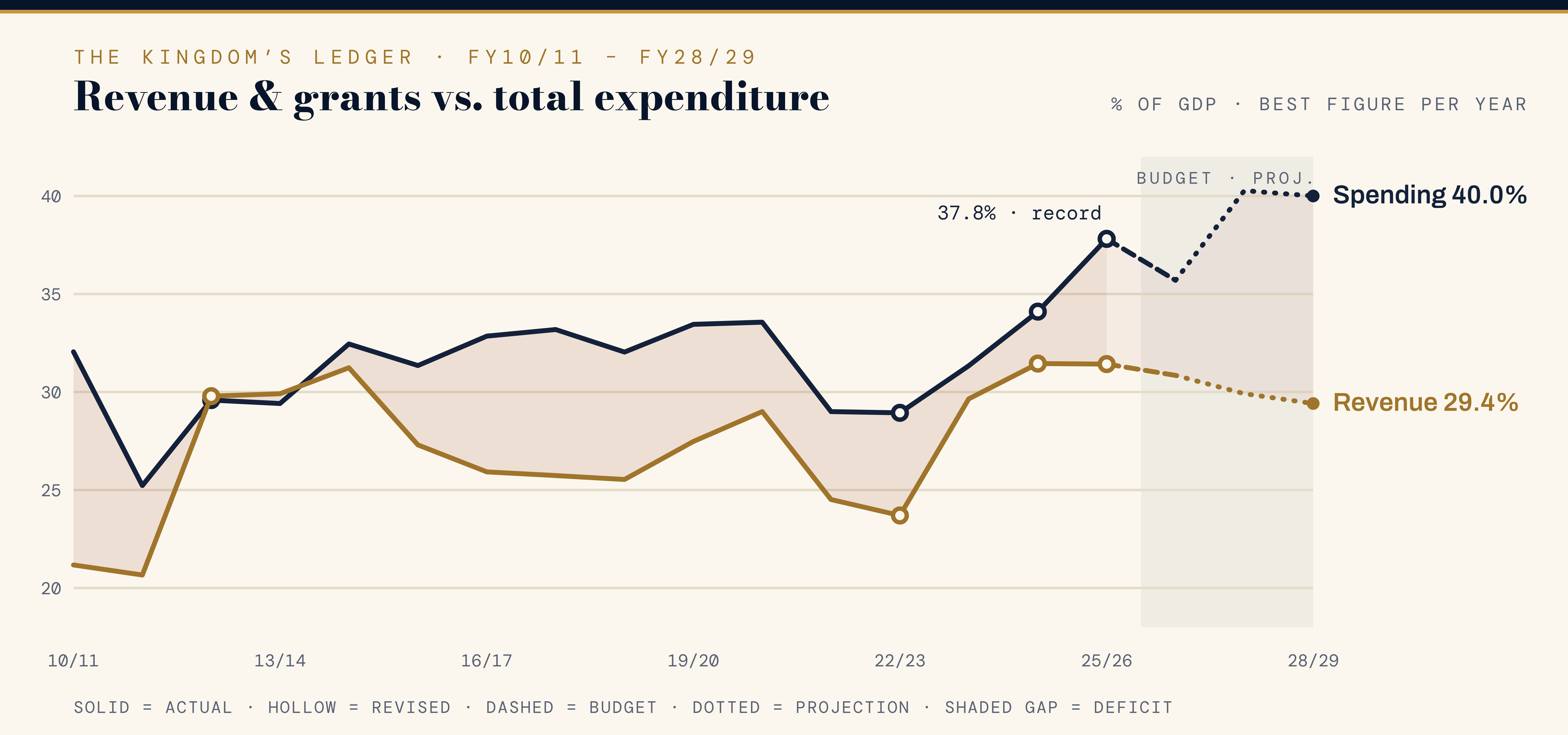
After government has paid salaries, serviced debt, honoured existing commitments and funded essential services, how much money remains available to respond to something it did not plan for?
That question matters because economies rarely respect budgets. A drought arrives. Fuel prices jump. A bridge after a violent storm needs urgent repairs. An economic downturn such as a conflict in the Middle East negatively impacts tax revenue. A country with fiscal space can respond. A country without it must first decide what to cut, what to postpone or how much more to borrow.
This is where the real cost of debt begins to emerge. Every lilangeni committed to servicing yesterday’s borrowing is a lilangeni that cannot easily be redirected when tomorrow presents a better use for it.
Debt, then, does not only cost interest. Eventually, it can cost choices. And this is where the national argument begins to resemble the financial decisions households and SMEs make every month.
Lessons for households
Suppose two households each earn E20 000 a month. One pays E5 000 towards debt and keeps some money aside for emergencies. The other has E12 000 disappearing into a mortgage, vehicle finance, personal loans and store accounts before groceries have even entered the conversation.
Their incomes are identical. Their financial strength is not. Then the gearbox gives up. For the first household, it is an unwelcome expense. For the second, it may become another loan.
That is what financial room looks like when translated from a national budget to a kitchen table.
It also explains why asking ‘How much debt do I have?’ is not enough. Ask what it costs you each month. Ask how expensive the interest is. Ask how long you have committed your income. Ask what the borrowing bought. And then ask the uncomfortable one: if my income fell tomorrow, how long could I continue paying?
The answers tell you considerably more about your financial position than the outstanding balance alone.
FOR SMEs, FOLLOW THE MONEY
Business owners should go one step further. Ask what the debt is producing. There is a profound difference between borrowing E100 000 for machinery that increases monthly production and borrowing E25 000 every few months because the business cannot cover salaries.
The larger loan may actually be healthier. Why? Because debt should leave something behind. New machinery can increase output. A delivery vehicle can open another market. Renovating productive premises can create capacity. Properly financed stock can meet proven demand.
Those assets have a chance of producing the income that repays the borrowing.
Repeatedly borrowing for ordinary operating expenses tells a different story. It may be necessary during a temporary shock, but if it becomes routine, the loan is no longer solving the underlying problem.
It is financing it. The same test should apply to public borrowing.
So, does Eswatini have a debt problem?
After looking beyond the headline ratio, the answer becomes clearer. Yes, but precision matters.
Eswatini’s problem is not simply that public debt stands at about E42 billion, nor does a debt ratio of roughly 40.4 per cent of GDP, on its own, make the country exceptionally indebted. It is worth adding that the IMF, which measures the debt more broadly, already places the ratio at about 45 per cent of GDP and expects it to reach 50 per cent by the end of the current financial year. Government’s own medium-term plans accept that climb before bringing the ratio back towards 45 per cent by 2029.
The concern lies in the pressure developing around that debt, the cost of servicing it, the need to refinance maturing obligations, persistent fiscal deficits and a revenue base in which SACU receipts can move substantially from one year to another.
That is not the language of imminent collapse. Nor should it be treated casually. The appropriate response sits somewhere between panic and complacency, discipline.
For government, that means protecting the distinction we made at the beginning of this two-part edition. Borrowing that expands productive capacity can strengthen the economy that eventually carries the debt. Borrowing that repeatedly fills the gap between ordinary revenue and ordinary expenditure does something else.
It buys time. And time becomes expensive when purchased repeatedly.
For households and SMEs, the lesson is remarkably similar, even though a national budget is obviously not a household budget. Do not judge financial strength by how much someone is still willing to lend you. Look at what your repayments consume, what the borrowing produced and, crucially, how much room remains when something goes wrong.
So perhaps the final question for Eswatini is not whether E42 billion is too much. It is whether the country can ensure that what it borrows today creates enough growth, revenue and productive capacity to preserve its choices tomorrow.
Because whether the balance sheet belongs to a country, a company or a family, good debt should leave you with more possibilities than it takes away.
The real measure of financial strength is not simply whether you can make the next repayment. It is how much room to breathe remains after you do.