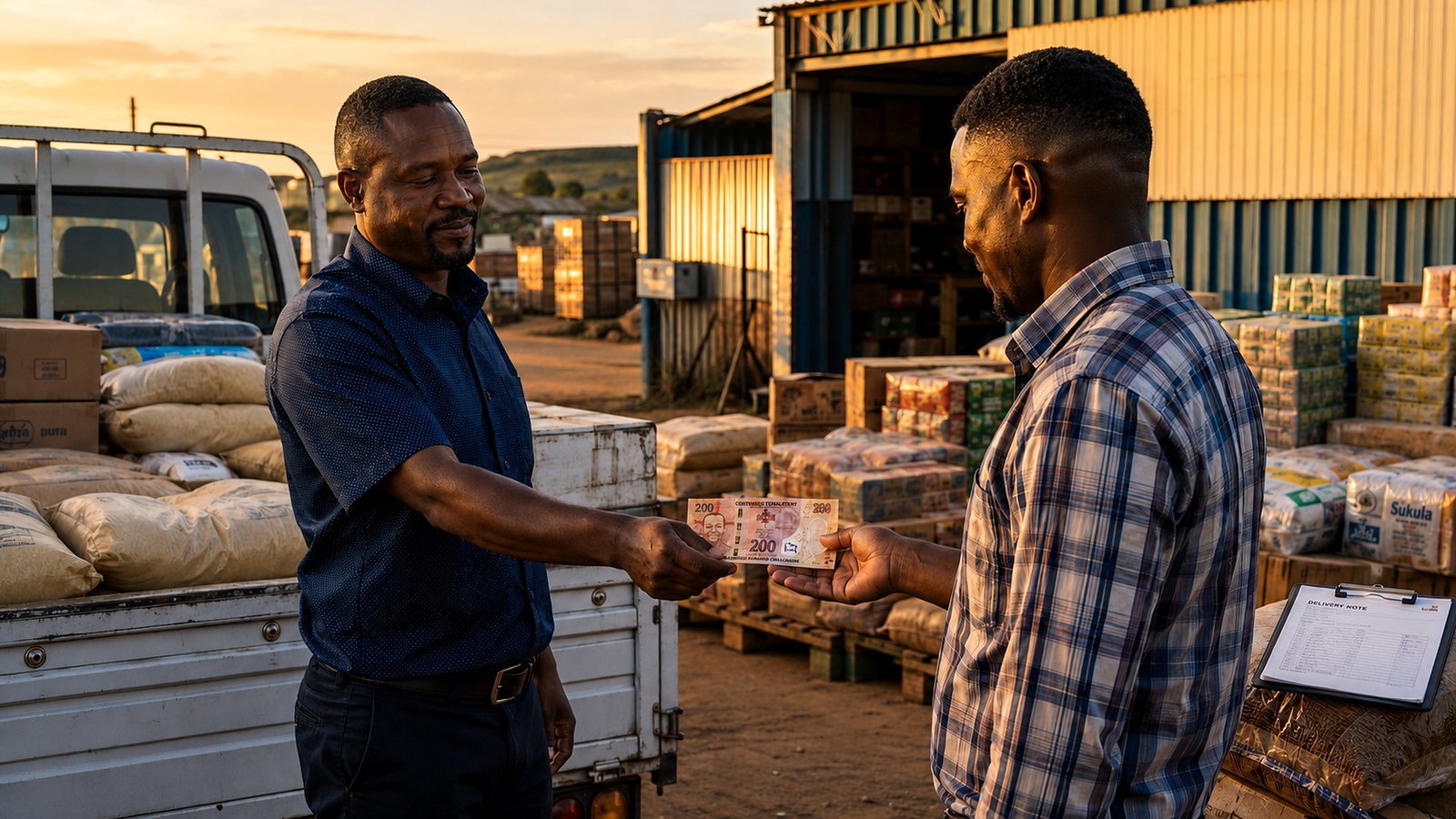

Most of us think debt begins when we borrow from a bank, yet some of the most expensive loans we ever take carry no paperwork, no repayment schedule and no bank logo.
They begin the moment we fail to pay someone who has already kept their side of the bargain. The remarkable thing is that almost nobody thinks of it that way. Instead, we tell ourselves we simply need a little more time.
“I'll pay you at month-end.” “Business has been slow.” “Things are a bit tight right now.” These are the quiet promises that circulate through almost every economy. Most of us have made them. Most of us have trusted someone else when they made them to us.
Sometimes those explanations are entirely genuine. Salaries arrive late. Businesses lose customers. School fees appear all at once. A vehicle breaks down. Life has an irritating habit of rearranging even the best financial plans. None of that is unusual.
What is unusual is how rarely we stop to ask the question quietly sitting beneath every unpaid invoice: If I haven’t paid, who is carrying the cost instead? That question changes everything because someone is financing our delay.
That is perhaps the hardest truth about unpaid debt. Money does not disappear because we hold on to it. Neither does the financial pressure. It simply moves. The burden that was sitting in our account quietly shifts into someone else’s.
When trust becomes credit
We struggle to feel this because of how the human mind works. We respond instinctively to problems we can see. A child standing in front of us needing school shoes is real. A vehicle that suddenly refuses to start is real. Electricity about to be disconnected is real. The supplier waiting for payment is usually not.
Once we leave the conversation, they become an abstraction and abstractions are remarkably easy to keep waiting. Behavioural economists have long observed that people respond far more strongly to visible, immediate problems than to distant ones. Put more simply, we react to faces far more readily than to statistics.
The difficulty with late payment is that, at the moment we decide not to pay, there is no face in the room. There is only our own relief. The person carrying the burden still exists. We simply no longer feel its weight. Perhaps that is why so many otherwise honest people delay payments without ever thinking of themselves as borrowers.
Economists usually describe credit as borrowing money today and repaying it tomorrow. There is another way to think about it. Credit is borrowed trust. Money simply happens to be the vehicle through which that trust travels. That distinction matters because not all credit originates inside financial institutions.
Think about the local supplier who delivers stock to your business and agrees to wait thirty days for payment. Think about the electrician who completes the repairs before sending an invoice. Think about the neighbour who buys groceries for a funeral because everyone promises to settle their share later.
None of these people opened a bank. None intended to become financiers. Yet each has quietly extended credit because they trusted that their money would return when it was supposed to. Trust, in other words, has value.
Problems begin when repayment quietly becomes optional not because people wake up intending to cheat one another. More often because delaying payment has become normal. We have grown comfortable treating other people's money as an extension of our own cash flow, convincing ourselves that another week, or another month, will make little difference.
The irony is that those extra days often matter far more to the person waiting than to the person delaying. That is where the ripple begins. The household that postpones payment experiences temporary relief. The supplier inherits temporary pressure. The supplier delays paying the wholesaler. The wholesaler postpones settling another account. The contractor delays replacing equipment. An employee waits a little longer for their salary. One unpaid invoice quietly becomes several.
Economists call this the circulation of money. Every time it changes hands, it pays wages, settles invoices or creates another opportunity. When that circulation slows, the effects spread quietly through the economy long before they appear in official statistics.
Perhaps the greatest irony is this. Many people who complain about customers paying them late are, often without realising it, doing exactly the same thing to somebody else. That is how financial pressure reproduces itself. Not always through greed. More often through habit. And habits, as we explored in recent editions of Plain Money, have a way of becoming invisible precisely because we repeat them so often.
Hidden tax of paying late
The same principle extends far beyond households. Every year, businesses across the country complain about late payments. Contractors complete projects and then wait months to be paid. Suppliers deliver stock only to spend weeks chasing invoices. Small businesses often find themselves financing much larger organisations without ever agreeing to do so.
For many SMEs, cash flow is not destroyed because the business is unprofitable. It is destroyed because somebody else has failed to honour a commitment. That is why paying on time is not simply good manners. It is one of the most important economic decisions any business, or household can make.
Why this matters in Eswatini
The consequences are magnified in a small economy like ours. Eswatini is not an economy of strangers. It is an economy of relationships. The contractor waiting for payment today may be buying stock from someone you know tomorrow.
The wholesaler delaying payment to a supplier may be serving your local supermarket next week. The business struggling to pay salaries may employ your neighbour, your cousin or someone sitting next to you at church on Sunday.
Money travels surprisingly few hands before it reaches another household. Financial pressure does the same. In larger economies, those ripples can dissipate before they reach you.
Here, they often return to your own doorstep. That is why trust is far more than a personal virtue. It is economic infrastructure. Roads allow goods to move. Electricity allows factories to operate. Trust allows money to circulate. Without it, every transaction becomes slower, more expensive and more uncertain.
It is also why paying on time is not simply an act of financial discipline. It is an act of economic stewardship. Every payment made when it is due allows someone else to honour their own commitments, keeping money moving through businesses, households and communities instead of trapping it in one place.
Most valuable asset you will never see
There is another reason this matters. A reputation for paying people when you said you would is one of the few financial assets that costs nothing to begin building, yet becomes more valuable every year you protect it. Suppliers remember. Customers remember. Employees remember. Banks remember.
People naturally want to do business with those whose word means something. They offer better terms, show greater patience when genuine difficulties arise and think of them first when opportunities appear. Reliability has a way of opening doors long before money does. Trust compounds. So does unreliability. Neither appears on a balance sheet. Both eventually shape what appears on one.
None of this suggests that every late payment reflects carelessness or bad character. Life happens. Businesses lose contracts. Medical emergencies arrive without warning. Salaries are delayed. Families experience genuine hardship. There are moments when asking for more time is not only understandable, but unavoidable.
The difference lies in how we respond. Most people are remarkably understanding when someone is honest before a payment is due. What damages relationships is rarely the delay itself. It is the silence that often follows it.
A difficult conversation today usually protects far more trust than an excuse offered weeks later. Honouring your commitment does not always mean paying on the exact day you intended. Sometimes it means communicating openly when you know you cannot. That, too, is financial discipline.
Currency that matters most
Perhaps that is the deeper lesson behind today’s conversation. Over the past few weeks, Plain Money has explored inflation, borrowing, money habits and planning. Each topic has looked different on the surface, yet all of them have quietly pointed to the same idea: good financial decisions are rarely about money alone. They are about judgement.
Money works because people trust one another. Banks function because people trust them. Businesses trade because they trust invoices will be honoured. Families lend because they trust promises will be kept.
Strip away that trust and the economy becomes slower, more cautious and more expensive for everyone. Every payment we make tells a story. It says something about our priorities and planning. Above all, it says something about whether other people can rely on us. That may sound old-fashioned, but in reality, it is one of the most modern financial advantages anyone can possess.
In an economy where uncertainty has become normal, trust has become one of the most valuable forms of capital available. Money can usually be earned again. Trust almost always takes longer to rebuild.
Perhaps that is why one of the soundest financial habits any household, business or institution can develop has nothing to do with interest rates, investment portfolios or complicated financial products.
It is becoming the kind of person whose promises can be counted on. After all, every debt is eventually settled in one of two currencies. One is money. The other is trust.
In the long run, it is usually the second that proves more valuable. Before allowing another payment to slip quietly into next week or next month, perhaps there is one question worth asking: If somebody did the same to me, would I still believe it was fair?
If the answer is no, then you already know what financial discipline requires. Pay what you owe. Honour your word. Economies are built one promise at a time.